mikegreenimages

Mike Green's thoughts on landscape photography

Posts tagged ‘Arizona’

Locations for photography: Canyon de Chelly, Arizona

My final ‘locations for…’ item from the US

Were I to write about all of the remainder of the locations we visited in the US recently, and which I’ve not yet talked about in the last few articles, I’d be covering old ground, both in the sense that they are very well-described on the web already, and in that I’d be repeating some general observations which I’ve already written. Monument Valley, The Grand Canyon, Bryce Canyon, they’re all much-photographed and very familiar subjects to many people. They are all, of course, well worth visiting simply to experience the grandeur and sheer scale of each of them.

Canyon de Chelly is another matter. Maybe it’s just me, but it feels considerably less well-known than everywhere else on our drive. It was recommended to me by a number of US friends, however, so perhaps it’s more prominent as a destination if you live there?
Canyon de Chelly track
For those who’ve not heard of it, it’s a y-shaped canyon near Chinle, not far from the New Mexico state line and deep in the Navajo Nation area of Arizona. It starts off, at the point where you access it by vehicle, level with the surrounding land and rises to something in the order of 300m. at the far end of each of the two upper parts of the ‘Y’. It contains a river, through and along which you drive (are driven, in most cases) when taking a tour. Along its rim are numerous overlooks from which it’s possible to look down, and from one of which a descent to the canyon floor is both easily possible and permitted. Apart from that, access is only allowed with a Navajo guide.

The dominant features of the canyon are red sandstone, cottonwood trees, the meandering river, and numerous ancient, native American dwellings built into the cliff walls at various heights. These indicate how high the canyon floor was when they were built and date back nearly a millennium in some cases. It is, I can comfortably say, a marvellous place to visit.

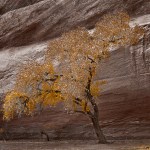
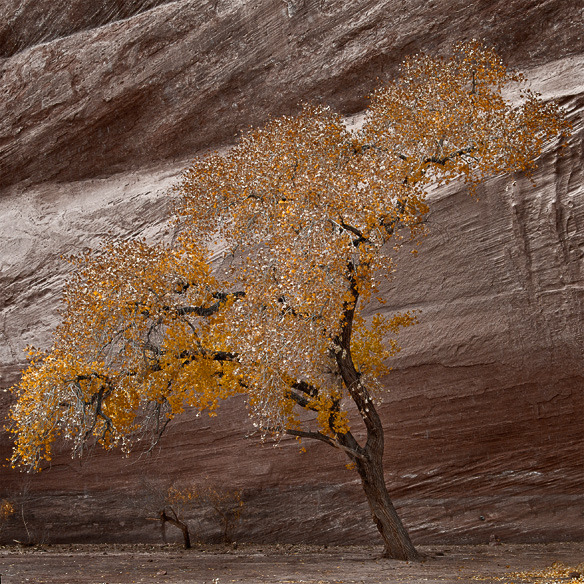
Our Navajo guide was excellent, being very knowledgeable about the history of the place, as well as tolerant of frequent stops for photography and just wandering about. He waited ages, for example, whilst I attempted to find an angle which would allow me to exclude the green fence which marred the lower-right corner of the image below. I failed at the time but removed it later after some kind advice on Flickr. His tolerance may have been helped by it being off-season, though I think he was just very helpful. We also weren’t hanging about too much since a major storm system had skirted the area the day before and was still putting down snow throughout our time in the canyon (as can be seen in the images in this article, especially when viewed in the larger sizes).
Golden Fleece

But is it good for photography?

I think so! As with all canyons, capturing the scale is tricky, and the nature of access, by 4×4, through a river, and with a guide, means that repeated trips might be necessary to really work out what to do with the subject matter (this would become expensive!). Nonetheless, there are some very interesting colours in the trees and the canyon walls, and some spectacular views from the canyon rim.

We had just a half day in the place, which was sufficient, given the rather low ambient temperature and constant snowfall, but I saw a great many interesting rock formations, groups of trees which simply must have compositions within them, and areas of the river where reflections and winding sub-streams would make interesting abstracts.

Considering the wider area beyond the canyon itself, this is very much deep in Navajo country, and there were very few people indeed who were not native Americans – neither in the motel we stayed at, nor in the surrounding area. It was a fascinating cultural experience as a result. I was particularly amused by being informed at a fuel station, by a boy who looked about 3-4 years old, that “You’re not Navajo”, in a tone which suggested that this observation was worth making, at least to him!

I have no idea how busy the canyon becomes in peak times of the year, but visiting it in December, when we were the only vehicle there, was an excellent experience.

To return to the wider trip. I’m not going to write anything more as I have nothing photographic or observational to say about the other locations, other than that they’re as good as they’re reputed to be! I shall, however, finish with the following images from a sunrise and a sunset at Bryce Canyon, purely since the sheer vibrancy of the colour on the hoodoos was astonishing, even though I’d seen countless images of them before. These shots have both been desaturated considerably.
Bryce Canyon hoodoosBryce Canyon hoodoos

Tripod substitutes

Both images are also examples of captures made with the assistance of the Mandypod, an excellent tripod substitute which I promised to mention in one of these articles.

Whilst only a bipod (biped, technically), and only five feet high, this device is very flexible and makes a fairly good camera support when a tripod is not available. It did tend to vibrate, or shiver, slightly when the temperatures (as for the sunrise image) dropped to minus 19C, but it was, nonetheless, considerably better than hand-holding the camera, since I was shivering rather a lot at the time too… Not only that, but it’s self-powered, does not require carrying, and occasionally responds to voice commands. Height adjustment is naturally limited to six positions: the camera is located on top of the head or shoulder and this is combined with instructing the ‘pod to sit cross-legged, kneel, or stand upright. These six levels were invariably adequate, however. Extra stability can be achieved by locking the camera-holding arm around the neck of the ‘pod and bearing down firmly, although this could lead to stability issues if maintained during an exposure of more than a few seconds (due to a process known as asphyxiation). I was very grateful indeed to have the use of this device on a number of occasions when strong winds would otherwise have made shots impossible :-)


Thumbnail links to gallery for this article

Musings on: not being eaten whilst photographing landscapes

We’re lucky with our wildlife in the UK. We don’t have:

  • Bears: black, brown, grizzly or polar
  • Big cats: OK, there may be a few on the loose, but they’re at best very elusive!
  • Snakes: yes, there are a few, but they don’t have fatal, or terribly serious, venom.
  • Spiders: not the deadly sort at least, with a few airline stowaways being very much the exception.
  • Coyotes: though there are some wolves in Scotland now I believe.

We have no need, in Britain, for signs like this one:

Of course, if you’re out trying to photograph any of these animals, the UK’s sadly lacking and clearly not an ideal choice, but, if your interest is landscape photography, the absence of assorted, powerful carnivores and venomous biting things is a major benefit!
'Snakes warning sign'

This item was originally conceived as entirely light-hearted, but I’ve been thinking about it some more and there is a serious point too: making landscape images, which usually involves considerable time standing around, concentrating on the camera and the subject, is a great deal more relaxed in an environment where nothing either predatory or venomous is out to get you.

What made me think about this was spending a few weeks in the US south-west, an area where all of the above may be seen or, potentially, not seen until it’s too late. As I said in my previous article, this wasn’t a photographic trip and I therefore didn’t spend much time immobile, awaiting the arrival of a hungry something, but if I do go out to the region again, with intent to photograph landscapes, I suspect that being out in the wilds alone could well be considerably less relaxing than it is here.

It’s not as if there’s an easy rule to follow :-\

Quite apart from anything else, remembering how to respond to any given encounter is a bit of a challenge. The variations in whether or not to look at an animal, whether to make a noise, whether to be aggressive or passive, are considerable! (Broadly, though: looking at bears is a bad idea, whilst anything feline really doesn’t like being stared at one little bit. As to snakes… well, don’t step on them and don’t get within about three metres, especially if they rattle!)

'Bears warning sign'

Naturally, weather is something we have to contend with in Britain, but it’s not actively malevolent and out to get you. Weather can kill, and I’m sure it does so to a far greater degree than all of the wildlife above put together, but it’s passive and, to a reasonable degree, predictable (or so the met office claim at least). It’s most emphatically not worrying in quite the same way!

The real risk isn’t the issue; it’s a question of concentration

I genuinely think that landscape photography in the UK has many advantages over what might appear to be more dramatic landscapes elsewhere (colour palette, variety, accessibility, to list a few), and this is just an additional factor – but perhaps a very significant one. I’m not at all sure how well I could concentrate on producing the best composition I’m capable of, and waiting for the light to be optimum, if I was worrying about being eaten or poisoned! OK – I do know: not very well at all. For example, the rattlesnake warning sign at the top was vaguely amusing at first, but less so when we were standing on a lookout and noticing all the suspiciously circular, snake-sized holes in the desert surrounding us.

I don’t want to get the real risk out of proportion here: the number of fatalities attributed to the entirety of the above list of animals, per year, in the whole of the US, is measured in tens, so the risk is trivial. What I’m talking about here is the – to me – undeniable nervousness produced by these dangers existing at all, and the effect that would have on my photography. i.e. This is really a musing on how the potentially dangerous wildlife which may be nearby at a location affects [my] ability to make photographs. Much as the factors I discussed in my general article on photographing this area – time, equipment and over-familiarity – had a profound effect on my images, I think that this feature of the less-benign environments of the US south-west could also have a considerable, detrimental effect, purely through psychology :-(

'Lions warning sign'

I’d be interested in whether anyone who’s been out making landscape images – especially solo – either in this area or in others where potentially threatening animals are present – has had similar thoughts, or been affected by the simple concern about this, in reality trifling, risk?

Locations for photography: Antelope Canyon, Arizona – one piece of advice!

'Antelope tumbleweed'

Go there, if you possibly can – but go at the ‘right’ time of year!

I strongly suspect that the majority of people reading this will already know what Antelope Canyon, near Page, Arizona is, and what it looks like. If you don’t, a ‘net search will produce a wealth of images of orange, purple and yellow swirls of striated, curvaceous rock. Without hyperbole: it’s stunning! Whether it’s the most stunning slot canyon in the US is a question I can’t answer – there are rather a lot of them; notably an entire national park called ‘Canyonlands’, which presumably contains at least the odd few – but it’s surely ‘up there’, and it’s extremely accessible.

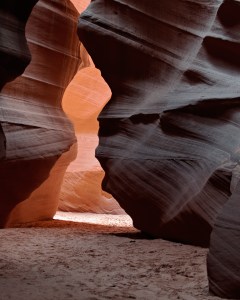
Antelope CanyonAlong with the wealth of images available on-line is a similar abundance of advice and guidance on how to photograph the canyon, so I’m really not going to repeat it all (you’ll be pleased to know!)

In summary, however:

  • the canyons (Upper and Lower) are deep, dark slots in sandstone;
  • the light at the bottom is therefore a) minimal in most places and at most times, b) very, very bright in other places…
  • If you go equipped for this – and also bearing in mind that your probable, desired points of near and far focus in a given frame may range from tens of centimetres to a few tens of metres – then you’ll find numerous achievable compositions throughout the short length of the canyons.

It would be really quite difficult, I suspect, to go in there and not come away with at least a few shots which could be considered pleasing, even if you were to randomly point the camera in a vaguely upward or horizontal direction and press the shutter repeatedly! (Note: ‘pleasing’, as I think mine are, not necessarily ‘good’, and it would certainly be a challenge to add anything new to the existing wealth of images of the place! That said, I am very pleased with the tumbleweed image at the top of this article!)

The tricky thing is the myriad of other people…

Antelope Canyon…or so I’d been informed by reading a fair few pages of photographic advice. Our Navajo guide, Brian(!) told us that he’d counted 3,000 people leaving the Upper canyon in one hour one summer day, whilst waiting to lead his group through… We did press him on this, and he insisted that he’d literally counted them. Having been there, it seems hard to believe those volumes to be physically possible, and I would personally not have entered in those circumstances. Nonetheless, even assuming that he was exaggerating for effect (if so, he succeeded there; we were appalled!), it clearly does get very busy – everyone says that.

But it’s not always like that

What everyone doesn’t say is that this somewhat distressing, even alarming, throughput of people is not constant throughout the year. This was Brian’s point, and he was making it since we were the only people in the canyon at the time. You enter and exit at the same end in Upper Antelope (which is where we were) so everyone who enters is obliged, on their way out, to pass the groups who have followed them into this often narrow passage. In our case, we met just one group of seven people as we left: that was bad enough, and I don’t like to imagine what a busy, summer day is like :-\

Unfortunately for me, I’d believed the stories of gross over-crowding: the near-impossibility of setting a tripod up; the constant jostling for a view; and the likelihood of people constantly throwing sand in the air to catch the light. Consequently, I had no tripod and only one lens. Had I known that the two of us, plus Brian, would have the place to ourselves for an hour, I’d have brought extra kit from Europe, just for that hour!

Importantly, we were there in early December. i.e. between the two major US holidays of Thanksgiving and Christmas. Antelope, along with everywhere else we went, was enjoying its deepest ‘off’ season of the year.
Antelope Canyon line detail

I’d choose this month again, without hesitation

  • Yes, the weather could be an issue: we did have some snow, but nothing which affected our travel more than to extend journey times a little on a couple of occasions.
  • Yes, the famous and beautiful light beams, which pierce the narrow opening of Upper Antelope and illuminate the sandy floor at predictable times of day (and encourage people to throw sand into the air…) are not present in December: the Sun is too low in the sky to ever reach the floor of the canyon. Personally, I was happy to miss out on these beams, given that it meant the confined space was devoid of the summer hordes.

I should also say that we were the first party of the day to enter the canyon, which probably helped. There were, however, only about ten people getting ready to go in when we left, so it didn’t appear that the Navajo were going to have an exactly bonanza guiding day.

I can’t emphasise enough how fabulous the place is when you have it to yourself, irrespective of photographic potential. And if you are going to photograph it carefully, and need to use a tripod (and I’d say that having one is close to essential for lots of compositions), then going at a busy time would be, at best, very frustrating indeed. Lower Antelope is supposedly still quieter, but the flow-rate of visitors is now also rising as the Upper canyon has clearly reached capacity on busy days.

So, that’s my recommendation: go, if you can, and go in December.
Antelope Canyon pink detail


Thumbnail links to gallery for this article

Musings on: bonsai landscapes in the US south-west

For my first article about the western desert of the US, a few thoughts about how preconceptions of landscapes, as well as the circumstances in which we visit them, can affect our approach to photography – well, my approach at least, but I’m daring to assume that I’m not unique in this!

No, ‘Bonsai landscape’ is not the most usual description of the south western desert area of the US! My alternative title to this piece was:

‘Musings on: how over-familiarity, equipment availability, and travelling style affect the way we view landscapes’

…. but that was a teeny bit verbose; not to mention that I like the term ‘bonsai landscape’ to describe the very small areas, often with tiny bushes in them, which I seem to have photographed predominantly whilst there.

I’ll step back here and provide a bit of context.

I’ve just returned from a road-trip touring around various ‘big ticket’ sites in California, Nevada, Arizona and Utah, centred around Las Vegas as a convenient and pleasingly bizarre place to enter and exit the US. The thing is, it wasn’t a photographic tour, it was a non-solo, driving holiday, and the point was to ‘see the sights’, which meant Death Valley, the Grand Canyon, Monument Valley, Bryce Canyon, Zion Canyon, Antelope Canyon, the Canyon de Chelly and all sorts of less well-known things en route. I’ve written before about the incompatibility of ‘serious’ landscape photography and non-photographer companions, so I reluctantly chose to take just a camera body, two small, light lenses and one [polarising] filter. My graduated filters, the two lenses I use for most of my images, and my tripod all stayed at home.

The effect of this was interesting.

  • Firstly, and not surprisingly, it avoided all the problems I’d imagined, had I taken all the normal kit and gone with ‘intent to photograph’: no issues with anyone else having to wait around whilst I set up shots and waited for changes in light, and the big benefit of not having much to carry around either!
  • Secondly – and this is the more interesting result, and the subject of this musing – I ended up making very different images, in general, from those I’d expected to concentrate on.

Tiny elements of a vast landscape

The south-western desert area of the United States is a huge landscape, characterised by vast skies, monoliths, and deep canyons – the sort of thing which lends itself to big vistas. That impression is reinforced by a quick on-line search, where the photographic results which come back are predominantly ‘big stuff’ with ‘impressive skies’. I have very few of those shots. Yes, I do have some, but I have considerably more detail shots. And it’s not even medium level detail, the type of thing I generally find myself capturing; they’re real detail of landscape elements measured in single digit metres across the frame – not something I’ve done much of before. Whether I shall again is another question…. I like the results, but I think I prefer my normal work, such as ‘Plateau’, below.

'Plateau'

At the time, I didn’t notice what I was doing….

I recognised this concentration on detail for the first time whilst doing initial processing on the captures I made during the trip. Prior to that, I’d not been at all aware that I was behaving differently, in terms of what I photographed, from normal.

I think there are three reason for this – temporary! – change in subject matter:

Equipment availability
I had no wide angle lens: my widest was 35mm on Nikon DX format, or about 50mm full frame equivalent; not exactly wide. I had no tilt-shift lens, no tripod, and no graduated filters: all these things are essential to how I normally take photographs, so, inevitably, I couldn’t do what I would typically do. Instead, I gave up on real front-to-back sharpness, any idea of including sky, and any exposure longer than about a 30th of a second. OK, so the sky aspect was no great change – I often exclude it, as discussed before – but the other two things were!
Time availability
Generally, I’ll hang around at a site for at least an hour, and more often two or three, making a single capture. Doing that sort of thing at every location on a long road trip would have been…. let’s say ‘not sociable’, nor productive in terms of the primary objective of ‘seeing lots of things’. As a consequence, most of my images took a matter of a minute or less to see, compose and shoot – a bit of a difference from my usual approach.
Over-familiarity with the landscape
I think this is the most significant factor. The two above are both strong, practical arguments for a different approach, and consequently for a different set of take-home images, but this is the one which, I can see now, really drove the change.

I don’t mean that I’d been to these places before; I hadn’t. Yet, with these iconic and stunning locations being both heavily photographed and included in innumerable feature films, I found myself acutely and accurately aware of what I was going to see before I arrived in most places. It’s great, for example, to have seen Monument Valley in the real stone (and the real snow, and the real ice, and the real, very bitter, wind), but I didn’t exactly learn anything new, visually, from being there. It looks as it does in the films, and many people have made excellent images of the mesas through a combination of familiarity and repeated visits. I wouldn’t seek, or be able, to emulate those. Essentially, in one day, I didn’t feel that I could add anything on the vista scale.

'Antelope waves'

These three things conspired to make me concentrate, unknowingly at the time, on small elements of the overall photographic possibilities in each place

Lack of time and kit meant that compositions were necessarily simple and quickly made, and my reluctance to try and capture the vast vistas in a manner which was new, or improved upon, existing work, led to abstract and detailed shots. These will, I’m sure, remind me of the trip very well indeed, despite the fact that relatively few of them could be placed on a map with any certainty. Given that ‘making memories’ was the main point of my photography on this trip, that’s fine!

And?!

In retrospect, perhaps all of the above was obvious: perhaps I could have predicted the type of capture I’d make? Maybe so, but I didn’t, and discovering this after the fact is quite enlightening – it’s another new thing to add to my gradually increasing understanding of the photographic process as a whole.

It does, of course, mean that, in future, I shall be more aware of the possibilities of different styles – or at least of different choices of subject matter – emerging when I travel in different circumstances, with different equipment, and with overall different objectives from ‘serious photography’. Personally, I think that’s great: change and new revelation in any pursuit is, I strongly believe, a good thing, and it maintains interest :-)

'Bonsai bush - Zion'

I’m sure much of the above is painfully obvious to many people reading this….. If so, thanks for reading this far! This journal is, as I’ve said before, aimed at recording my progress as a newcomer to landscape photography, and this really was quite a major revelation to me, whether it should have been or not!