mikegreenimages

Mike Green's thoughts on landscape photography

Posts tagged ‘canyon’

Locations for photography: Canyon de Chelly, Arizona

My final ‘locations for…’ item from the US

Were I to write about all of the remainder of the locations we visited in the US recently, and which I’ve not yet talked about in the last few articles, I’d be covering old ground, both in the sense that they are very well-described on the web already, and in that I’d be repeating some general observations which I’ve already written. Monument Valley, The Grand Canyon, Bryce Canyon, they’re all much-photographed and very familiar subjects to many people. They are all, of course, well worth visiting simply to experience the grandeur and sheer scale of each of them.

Canyon de Chelly is another matter. Maybe it’s just me, but it feels considerably less well-known than everywhere else on our drive. It was recommended to me by a number of US friends, however, so perhaps it’s more prominent as a destination if you live there?
Canyon de Chelly track
For those who’ve not heard of it, it’s a y-shaped canyon near Chinle, not far from the New Mexico state line and deep in the Navajo Nation area of Arizona. It starts off, at the point where you access it by vehicle, level with the surrounding land and rises to something in the order of 300m. at the far end of each of the two upper parts of the ‘Y’. It contains a river, through and along which you drive (are driven, in most cases) when taking a tour. Along its rim are numerous overlooks from which it’s possible to look down, and from one of which a descent to the canyon floor is both easily possible and permitted. Apart from that, access is only allowed with a Navajo guide.

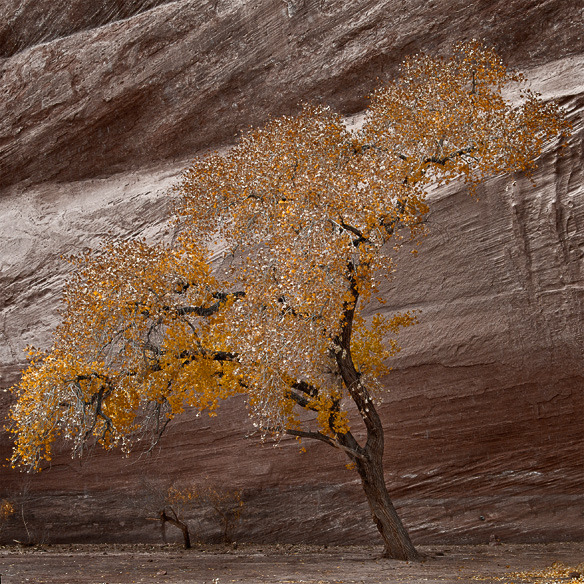
The dominant features of the canyon are red sandstone, cottonwood trees, the meandering river, and numerous ancient, native American dwellings built into the cliff walls at various heights. These indicate how high the canyon floor was when they were built and date back nearly a millennium in some cases. It is, I can comfortably say, a marvellous place to visit.

Our Navajo guide was excellent, being very knowledgeable about the history of the place, as well as tolerant of frequent stops for photography and just wandering about. He waited ages, for example, whilst I attempted to find an angle which would allow me to exclude the green fence which marred the lower-right corner of the image below. I failed at the time but removed it later after some kind advice on Flickr. His tolerance may have been helped by it being off-season, though I think he was just very helpful. We also weren’t hanging about too much since a major storm system had skirted the area the day before and was still putting down snow throughout our time in the canyon (as can be seen in the images in this article, especially when viewed in the larger sizes).
Golden Fleece

But is it good for photography?

I think so! As with all canyons, capturing the scale is tricky, and the nature of access, by 4×4, through a river, and with a guide, means that repeated trips might be necessary to really work out what to do with the subject matter (this would become expensive!). Nonetheless, there are some very interesting colours in the trees and the canyon walls, and some spectacular views from the canyon rim.

We had just a half day in the place, which was sufficient, given the rather low ambient temperature and constant snowfall, but I saw a great many interesting rock formations, groups of trees which simply must have compositions within them, and areas of the river where reflections and winding sub-streams would make interesting abstracts.

Considering the wider area beyond the canyon itself, this is very much deep in Navajo country, and there were very few people indeed who were not native Americans – neither in the motel we stayed at, nor in the surrounding area. It was a fascinating cultural experience as a result. I was particularly amused by being informed at a fuel station, by a boy who looked about 3-4 years old, that “You’re not Navajo”, in a tone which suggested that this observation was worth making, at least to him!

I have no idea how busy the canyon becomes in peak times of the year, but visiting it in December, when we were the only vehicle there, was an excellent experience.

To return to the wider trip. I’m not going to write anything more as I have nothing photographic or observational to say about the other locations, other than that they’re as good as they’re reputed to be! I shall, however, finish with the following images from a sunrise and a sunset at Bryce Canyon, purely since the sheer vibrancy of the colour on the hoodoos was astonishing, even though I’d seen countless images of them before. These shots have both been desaturated considerably.
Bryce Canyon hoodoosBryce Canyon hoodoos

Tripod substitutes

Both images are also examples of captures made with the assistance of the Mandypod, an excellent tripod substitute which I promised to mention in one of these articles.

Whilst only a bipod (biped, technically), and only five feet high, this device is very flexible and makes a fairly good camera support when a tripod is not available. It did tend to vibrate, or shiver, slightly when the temperatures (as for the sunrise image) dropped to minus 19C, but it was, nonetheless, considerably better than hand-holding the camera, since I was shivering rather a lot at the time too… Not only that, but it’s self-powered, does not require carrying, and occasionally responds to voice commands. Height adjustment is naturally limited to six positions: the camera is located on top of the head or shoulder and this is combined with instructing the ‘pod to sit cross-legged, kneel, or stand upright. These six levels were invariably adequate, however. Extra stability can be achieved by locking the camera-holding arm around the neck of the ‘pod and bearing down firmly, although this could lead to stability issues if maintained during an exposure of more than a few seconds (due to a process known as asphyxiation). I was very grateful indeed to have the use of this device on a number of occasions when strong winds would otherwise have made shots impossible :-)


Thumbnail links to gallery for this article

Locations for photography: Zion National Park, Utah

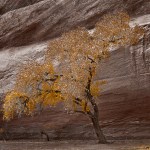
Cottonwood congregation

I spent four nights in Zion and made not a single ‘big landscape’ image

Perhaps that sounds odd, in that Zion is a vast canyon with soaring, near-vertical rock walls and a generous helping of overall magnificence. It was our last stop on the long trip around the desert south-west of the US though, and by that time I was reacting against big pictures and literally focusing on detail everywhere. Fortunately, Zion has an abundance of excellent detail!

As with the other locations we visited, Zion has already been heavily documented and photographed, so this is a short piece about my overall impressions of, and reaction to, the place.

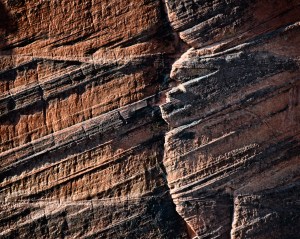
Zion cleftIn summary, and to be slightly contentious: it’s a US version of the English Lake District. I realise that anyone who’s been to both places will recognise that, in isolation, that’s a radically misleading statement. What I mean is that it feels like the Lake District; it’s atmosphere is strangely similar. It’s not the landscape itself that has this feel; it’s the way the landscape is used by people.

  1. It’s on a small scale – in fact, the principal canyon is not a great deal larger than Langdale, in terms of area, though it’s a winding, 10Km long, 500-700m. deep canyon cut into the surrounding desert.
  2. It feels very tame, compared to other national parks in the US south-west. Feels is the important word there: the Lakes don’t have cougars, rattlesnakes or bears, but then again, for most practical purposes, nor does Zion. The main areas are so populous with humans that the potentially aggressive wildlife stays well away. Conversely, the deer living on the canyon floor are so used to humans that they’re verging on tame and can be approached to within a couple of metres!
  3. Zion zig zagsIt’s manicured – not quite literally, though it is very neat. The owners of Zion Lodge (the only place to stay actually in the park) are currently converting most of the lawns around the buildings back to natural vegetation, yet the nature of the terrain means that the paths (sorry, trails in US-speak) are often the only option. Straying from them is sometimes forbidden, often impractical, and most are paved for the mile or so from the parking area which the average visitor will manage.
  4. StreamEven in the off-season, and mid-December is about as ‘off’ as it gets, we saw more people in Zion than anywhere else on our circuit. That’s not to say that it was anything approaching crowded, it was perfectly comfortable, but it certainly was relatively busy. I dread to think what summer is like, when the road up the canyon is closed to private vehicles and access is via what is apparently an excellent, multi-stop shuttle-bus service.

All those characteristics just kept making me think of Lakeland…. but a restricted Lakeland, one with:

  • less variety in its colours (a completely different palette in fact, but a more restricted one, at least in December);
  • Still deathless potential for choosing your own route from A to B;
  • and less space, both in real terms and in the naturally imposing nature of very high rock faces and a flat, narrow canyon floor littered with very neat, very well-maintained stopping places and viewpoints.

But hey, I like the Lake District – subject to the normal caveats of going there when it’s less crowded than it can often be – and I liked Zion. In particular, it was a great place to relax for a few days at the end of a long trip and many miles of driving.

Photographically, I found it excellent for the type of image I was, by then, making

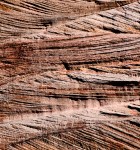
It’s true that the rock which makes up most vertical and horizontal surfaces does tend to be the same red/yellow sandstone throughout the park, but it consists of numerous layers, and those layers vary in their thickness, degree of erosion, and pattern. If you want to look for abstraction in rock, this is a fabulous place to visit. One rather pleasing feature is that semi-abstract compositions can be made wherein the scale is very hard to determine: some of the rock images above are tens of metres across, though they could appear to be an order of magnitude or two smaller, at a glance (they often do to me, and I took them!). For example, if you examine the top right of the zig-zag rock image above, at the large size, there’s a bush there. That bush is about the size of a medium-sized dog, whereas I keep thinking the whole image is a small area!

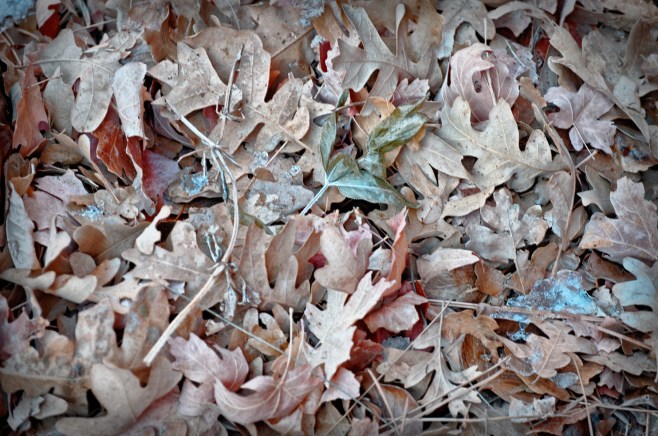
Frozen in amberIn early winter, there are also frequent pockets of ice to be found, held in the curves of small watercourses, often with decaying vegetation, both encased in the ice and lying on the surface. I used these to add some different colours to what was otherwise becoming something of a ‘red and granular’ series of images.

Zion ice creamWould I go there again? Yes, though I wouldn’t wish to go out of my way too much to do so, and if I did it certainly wouldn’t be in summer. Further, I’d be looking to concentrate on similar subjects to those I found this first time. A search on images of Zion will bring up many shots of the sheer grandiosity of the canyon itself, but examine those carefully and there are relatively few significantly different compositions – the nature of the place is that it has a number of viewpoints,and the sheer scale of the rock walls means that varying a composition from the norm is decidedly tricky. Moving away from those viewpoints very much, certainly in a direction which would enhance the composition, tends to require the power of flight!

I do strongly recommend a visit there if you have the opportunity, I’m certainly very pleased indeed to have gone; but set your expectations appropriately in terms of the type of photography it’s possible to practise, and enjoy it also for simply being a rather wonderful place with great drama, easy access and, if you’re vaguely fit and can follow steep, but well-trodden trails up to 700m. from the valley floor and back down again, some superb viewpoints.
Winter colour

All of the above is, of course, very generalised

It’s entirely possible to go to Zion and make some superb ‘big landscape’ images, as proven by the number of great photographs that exist showing it looking truly majestic. My approach was somewhat dictated by the equipment I had with me, but, as I said above, it had more to do with simply having had a near-surfeit of ‘big landscapes’ by the time I arrived there. That said, in this particular case, I do think that the wealth of small scale, detail / abstraction / texture / colour images are the most interesting subjects Zion has to offer…
Zion waves


Thumbnail links to gallery for this article