Locations for photography: Antelope Canyon, Arizona – one piece of advice!

Go there, if you possibly can – but go at the ‘right’ time of year!
I strongly suspect that the majority of people reading this will already know what Antelope Canyon, near Page, Arizona is, and what it looks like. If you don’t, a ‘net search will produce a wealth of images of orange, purple and yellow swirls of striated, curvaceous rock. Without hyperbole: it’s stunning! Whether it’s the most stunning slot canyon in the US is a question I can’t answer – there are rather a lot of them; notably an entire national park called ‘Canyonlands’, which presumably contains at least the odd few – but it’s surely ‘up there’, and it’s extremely accessible.
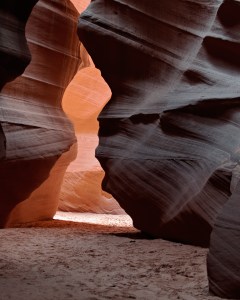 Along with the wealth of images available on-line is a similar abundance of advice and guidance on how to photograph the canyon, so I’m really not going to repeat it all (you’ll be pleased to know!)
In summary, however:
- the canyons (Upper and Lower) are deep, dark slots in sandstone;
- the light at the bottom is therefore a) minimal in most places and at most times, b) very, very bright in other places…
- If you go equipped for this – and also bearing in mind that your probable, desired points of near and far focus in a given frame may range from tens of centimetres to a few tens of metres – then you’ll find numerous achievable compositions throughout the short length of the canyons.
It would be really quite difficult, I suspect, to go in there and not come away with at least a few shots which could be considered pleasing, even if you were to randomly point the camera in a vaguely upward or horizontal direction and press the shutter repeatedly! (Note: ‘pleasing’, as I think mine are, not necessarily ‘good’, and it would certainly be a challenge to add anything new to the existing wealth of images of the place! That said, I am very pleased with the tumbleweed image at the top of this article!)
The tricky thing is the myriad of other people…
 …or so I’d been informed by reading a fair few pages of photographic advice. Our Navajo guide, Brian(!) told us that he’d counted 3,000 people leaving the Upper canyon in one hour one summer day, whilst waiting to lead his group through… We did press him on this, and he insisted that he’d literally counted them. Having been there, it seems hard to believe those volumes to be physically possible, and I would personally not have entered in those circumstances. Nonetheless, even assuming that he was exaggerating for effect (if so, he succeeded there; we were appalled!), it clearly does get very busy – everyone says that.
But it’s not always like that
What everyone doesn’t say is that this somewhat distressing, even alarming, throughput of people is not constant throughout the year. This was Brian’s point, and he was making it since we were the only people in the canyon at the time. You enter and exit at the same end in Upper Antelope (which is where we were) so everyone who enters is obliged, on their way out, to pass the groups who have followed them into this often narrow passage. In our case, we met just one group of seven people as we left: that was bad enough, and I don’t like to imagine what a busy, summer day is like :-\
Unfortunately for me, I’d believed the stories of gross over-crowding: the near-impossibility of setting a tripod up; the constant jostling for a view; and the likelihood of people constantly throwing sand in the air to catch the light. Consequently, I had no tripod and only one lens. Had I known that the two of us, plus Brian, would have the place to ourselves for an hour, I’d have brought extra kit from Europe, just for that hour!
Importantly, we were there in early December. i.e. between the two major US holidays of Thanksgiving and Christmas. Antelope, along with everywhere else we went, was enjoying its deepest ‘off’ season of the year.

I’d choose this month again, without hesitation
- Yes, the weather could be an issue: we did have some snow, but nothing which affected our travel more than to extend journey times a little on a couple of occasions.
- Yes, the famous and beautiful light beams, which pierce the narrow opening of Upper Antelope and illuminate the sandy floor at predictable times of day (and encourage people to throw sand into the air…) are not present in December: the Sun is too low in the sky to ever reach the floor of the canyon. Personally, I was happy to miss out on these beams, given that it meant the confined space was devoid of the summer hordes.
I should also say that we were the first party of the day to enter the canyon, which probably helped. There were, however, only about ten people getting ready to go in when we left, so it didn’t appear that the Navajo were going to have an exactly bonanza guiding day.
I can’t emphasise enough how fabulous the place is when you have it to yourself, irrespective of photographic potential. And if you are going to photograph it carefully, and need to use a tripod (and I’d say that having one is close to essential for lots of compositions), then going at a busy time would be, at best, very frustrating indeed. Lower Antelope is supposedly still quieter, but the flow-rate of visitors is now also rising as the Upper canyon has clearly reached capacity on busy days.
So, that’s my recommendation: go, if you can, and go in December.








 mikegreenimages