mikegreenimages

Mike Green's thoughts on landscape photography

Posts from the ‘Musings on: …’ category

Essays containing my general thoughts on just about anything photography related – mostly approach and philosophy, rather than technical or ‘how to’.

Musings on: the problem with multi-tasking

When I first started making photographs in what some people would call a ‘serious’ manner – going out with intent to photograph, rather than merely having a camera with me to capture memories – I took my camera and all my photographic kit with me every time I went out walking. I’ve stopped doing that, and this article is about why, and in what way that’s a good idea from the perspective of my future photography.

This post was inspired directly by a very good article from Richard Childs on his WordPress site; well worth a read. Richard’s post led me to recognise that I’ve been modifying my behaviour in capturing photographs over the last few months. It’s about – I’m paraphrasing wildly here – the disadvantages of combining two things:

  • the enjoyment of being out in the countryside;
  • and the enjoyment of making images.

As with so many combined activities, each can reduce enjoyment of the other. In particular, for me, going out to make photographs can definitely detract from certain aspects of the experience of being up a hill or mountain, or wandering in an area of woodland. Richard offers a solution to this problem and I have a slightly different one. That is, I do at the moment. Over time, everything changes and no doubt my current approach may evolve further.

Why doesn’t combining the above work well for me?

A considerable part of my enjoyment in the outdoors is being very aware of everything going on around me: the sounds; the change in wind direction and speed; signs of weather systems moving in or clearing; and the landscape being revealed as I move through it, whether due to change in position or change in the weather. I could list more, but I’m sure you get the idea: I have found that I like to feel involved and part of the landscape, and to do that well I need to be aware of everything that’s happening.

This sounds great for photography! After all, if I’m so aware of my surroundings, then I am presumably more likely to notice potential compositions. That’s true, it is good …. for photography, but not for walking and the whole outdoors experience; and hence, perhaps, in the longer term, not for photography either if it puts me off going out walking as much.

The problem – well, my problem – is that I do notice things, and then I stop, for a long time, work out a composition, then wait for the light to do whatever I think it might be going to do… All perfectly fine, except that if I have any kind of objective other than capturing images – getting to the top of a series of hills on a circular route perhaps – I either don’t have time to stop for long enough to make a good job of the composition, or I choose to do so and then don’t have time to finish the walk….

The image below, for example: I remember the immediate area around this small water flow in great detail, but I have near-zero recollection of approaching it, what the weather was doing, or how the surroundings looked. Given that this is in the valley between Buachaille Etive Mor and Buachaille Etive Beag, at the top of Glencoe, a spectacular setting, that seems a bit of a waste in some respects, though I was pleased with the image.
Claw

Now that’s not necessarily a problem on the odd occasion, but when it’s repeated on every walk – and that is what was happening to me earlier this year – it starts to mean that I’m not really doing ‘decent’ walks any more, I’m doing truncated versions of them. Great for photography, somewhat less so for the whole ‘going for a planned walk’ thing. Not only that, but in order to cater for unplanned images, I feel that I need to take all my photographic equipment with me. That adds weight and means that I plan shorter walks, another detriment to the walking part of the day.

And then there’s the disconnection from the landscape which I suffer when setting up a shot and concentrating on the photographic part of the combined activity: I lose the all-important awareness of what’s happening around me; my experience reduces to the image I’m making at the expense of everything else. After such a combined walking and photography trip, what I recall tends to be the composition and capturing of images, not the walking. Over time I’ve found that every trip has that photograph-biased character and that I’m not appreciating being out in the countryside quite as much as I used to.

So, I’m clearly not great at multi-tasking; fair enough! That said, I have a strong suspicion that many people aren’t, that it’s not just me. Yes, I can do multiple things at once, but I’m pretty sure they all suffer in comparison to giving each my full attention, and, by observation, I think this is true of the majority of people. Take the example of watching television or listening to a radio programme whilst reading or writing an email, if you’ve done that: did you miss bits of the programme, or write less coherently than usual in the email? If not, congratulations. If you did have that problem, think what it means for creative activities such as photography, or meditative ones such as walking. To me it implies that something will inevitably be lost from either or both experiences.

My take on this is that over time, were I to carry on like this, my ‘being outdoors for the sake of it’ activity would be diminished by the urge to take photographs, I’d start to resent the intrusion of photography into walking, and then not only would the walking suffer, but the photography would too, in that I’d do less, or hurry things. Since I want to do both, I had to come up with some kind of plan to avoid that happening.

A simple solution?

To address the issue, I’ve adopted the approach of not taking the camera equipment on things which I deem as walks. Conversely, I’m actively thinking of the walking part of photographic outings as merely the means of getting there, so my trips either have the objective of taking photographs, or of doing a good walk, but not both – it avoids later disappointment!

Of course, that’s a little absolutist and what I’m really doing when on ‘proper walks’ is making mental notes of places which I think are worth re-visiting with a camera on a dedicated, photographic outing; but I don’t spend any time working out the composition – I just note it as having image potential and move on, or return to watching the landscape and weather unfold for its own sake, rather than with the objective of capturing it in a photograph. I’m not about to completely divorce ‘going for a walk’ from taking photographs, but I am going to make sure that I make at least some outings purely for the sake of being out there, and don’t allow the photography to take over completely.

Do read Richard’s article for a subtly different take on this. I’m not convinced that what he proposes would work for me, but, fortunately, everyone’s different. The main point here is to ask yourself whether more specialisation (‘go for a walk’ versus ‘go out to make photographs’) is a good idea or not; whether the net effect, to you, of combining two activities is to enhance them both, or whether one adversely affects the other (and it can be either way around!).

It’s something that I’m sure is worth thinking about. The more things I do in all sorts of areas – not just photography and walking – the more I feel that I achieve more rewarding results when I concentrate on doing one thing at a time and doing it well. Incidentally, this series of thought ties in directly with my earlier musing on who to go out making photographs with, in which I reached similar conclusions on a different aspect of combining activities.

In summary: it would seem that I’m doing the same with my approach to all aspects of making landscape photographs as I endeavour to do in my actual images: simplifying.

Addendum

Julian Barkway has near-simultaneously published a blog article on a related theme which is also well worth reading. It brings out another facet of this area but is also, essentially, about not letting the making of photographs spoil your enjoyment of being out in the countryside. Clearly, this is a popular theme and one which it really is worth having a think about from your own perspective!

Musings on: an absence of sky

For several months now, I’ve made practically no images with sky in them. Only today, whilst flicking through my Flickr stream, have I noticed that. Interesting. At least, it’s interesting to me; in part due to the whole ‘failure to notice the trend’ aspect.

More significantly, I think it demonstrates that sky is far from essential in landscape photographs. Yes, many people, when they hear the term ‘landscape photography’, imagine a large vista: something prominent in the foreground; something pretty in the middle distance; and perhaps some hills or mountains against a dramatic sky to make up the top of the frame. Nothing wrong with that: I like, and make, photographs of that sort too, but for the moment I seem to be drawn to make what are often, it seems, called ‘intimate landscape photographs’. More precisely, or perhaps less precisely, I’m making images which, whether of a detail or of a large part of a scene, are abstracted from reality to some degree by the omission of sky, and by composing and processing for patterns, rather than for representation of the scene.

Midge-fest

I’ll sidestep the exact definition of ‘intimate landscape’, which tends to mean relatively small things, from what I’ve seen and read: I’m talking here simply about excluding the sky. The image above certainly qualifies as an ‘intimate landscape’, and I couldn’t have included sky even if I’d wanted to – the camera was pointing down to make the composition, quite apart from there being a wall of rock behind it. The shot below, however, could easily have included sky as a portrait format composition, but it added nothing and spoiled what I hoped would be a slightly claustrophobic and ‘dark’ feel to the tree, the fence, and the converging lines centred on the trunk.

Glen Etive woodland

So why is excluding the sky often good?

I’ve been in Scotland, the Glencoe area, for the last couple of weeks. Without doubt it’s a fabulous place, one of my favourites (though I think the open spaces of the far north-west of Scotland are better still). Everywhere you look there are dramatic mountains and wonderful, panoramic views; yet I didn’t include sky in a single frame! I’ve been trying to work out why this was, and the following are my ideas to date.

  1. I was there on a walking trip, not a photographic one, so I didn’t have the time to wait for light, nor to get to places suited to the ‘big vista’ style of shot whilst by myself.
  2. The ‘big’ landscapes, the ones with dramatic sky, tend to rely on just that: lots happening in the sky. It was grey and overcast on most days. Lovely, even light, but no drama.
  3. Without late or early light on the hills to emphasise the colour and contours, photographs tend to rely on pattern, and if that’s the case, what’s the point of including a grey sky, or of including a sky at all? (I was not alone, and photographing at dusk and dawn tends to be a wee bit intrusive in those circumstances!)
  4. Summer: now that’s a big issue. There was a hint of autumn about, but essentially the landscape was green and grey, vegetation or rock – not too thrilling really. Once autumn gets going, multi-coloured landscapes can draw out shapes and patterns on hillsides – the colours can be patterns in their own right. At the moment, there’s simply too much green around for my liking.
  5. As soon as sky is included, there’s a constraint. The inclusion of sky imparts an unavoidable feeling of ‘representation’, to me; it removes the idea of abstraction and imposes a “this is a picture of a landscape” feeling on the viewer; certainly, it does to this viewer.

That final point is the major item to me: sky can be useful, even essential, but it shrieks ‘picture!’. That’s not to say that absence of sky avoids the idea of ‘picture’, but it certainly can do so. I’m more interested in creating images which convey how I feel about the landscape, or how I see it, rather than in representing how it truly looks (something of a challenge in any case, in a two-dimensional image). I think I’ve written, in a previous article, that I like abstract art, and I feel that my attraction to form and pattern, whether created by water flowing in a stream or by clefts in hillsides (or even by clouds, potentially…..), makes including sky with land, in the conventional manner, decreasingly appealing to me.

Considering the other points, excluding sky is a rather good technique to avoid the issues associated with many of them. In particular, on a dull day, or at least one with a grey, evenly luminous cloud cover, the fact that everything is uniformly lit is a distinct benefit in this type of ‘no sky’ image-making. The colours can be successfully drawn out or muted, as required, in post-processing, as can the tonality, via dodging and burning, to emphasise existing shapes and patterns. When using this approach to post-processing, it’s far better to start with a neutral, evenly lit capture than one which is strongly influenced by the light and constrained by the need to produce a ‘natural-looking’ sky. Dull days are great for this: they provide an even, low contrast illumination which allows the camera to capture lots of detail and gives huge flexibility, during post-processing, in deciding how that detail is best used.

Necessarily greater creativity, and more likelihood of unique images

Another very strong argument in favour of the ‘zero sky’ approach is that it’s more likely to produce unique images. Everyone sees the details in a landscape differently, whether those details are the juxtaposition of a couple of rocks and a piece of heather, or whether it’s a pattern on a hillside. Seeing things differently leads to capturing different compositions and making more varied images from them – this can only be good! The image below, repeated from an earlier post, is a good example I think. The skyline is just above the top of the frame, but the sky added nothing to the shot. In fact, I’d argue strongly that the sky would have ruined this, taking away from the graphic, pattern-centric effect of the sweep of the waterfall and the multi-coloured, right hand slope.

Curve

Of course, I’m not remotely advocating that sky should not be included as a principle. All I’m really saying is that it should only be included where it adds something to the final image, or where the goal of the image is to be representational. For the moment, I foresee the majority of my images only including solid or liquid subject matter; equally, I foresee that current preference changing over time and according to circumstances….

For more, arguably better, examples of excluding sky – which are certainly not ‘intimate’ in any way – see my previous post, a couple of the images in which are on a very large scale but feature solely ground and water.

As always, I’d be very interested to hear your views on this, whether supportive or contradictory.

Musings on: aspect ratio as a creative choice

I have a list which I add to whenever I think of something I might like to write an article about. Items on that list come and go, either since I get around to writing the piece, or because the subject no longer seems interesting, or perhaps because I’ve come across so many articles on the same topic that it seems redundant to add to the wealth of material ‘out there on the web’. ‘Aspect ratios’ has been on the list for longer than anything else at this point; it was one of the items on my very first list in fact, and it’s neither been written, nor deleted from the ‘to do’ section.

I was wondering why that was.

  • It’s not uninteresting: the shape of an image is a significant factor in the finished photograph.
  • It’s not as if there aren’t many articles on the subject: indeed, there are short books covering nothing but aspect ratios.
  • It’s not that the existing articles and books aren’t informative, useful and well-written, or some permutation of one or two of those three factors.

Rather, it’s because, whilst I’ve read a fair few articles on the subject, none of them so far has closely matched what has come to be my view on aspect ratios and how they can be used in making images. (The usual caveats apply….. I’m developing as a photographer, and I entirely accept that I may become fixated on some specific aspect ratio as my work develops….but, right now, the following is what I think!)

Why is the debate on choice of aspect ratio often so contentious?

Many, though not all, writings about aspect ratio choice verge on the evangelical: ‘x:y is the best’ or ‘x:y is best for subject matter A, whereas m:n is best for subject matter B …’, etc. I’ve been intrigued for some time as to why there is such heated debate – I still am! To me, the arguments seems relatively uncontentious. More precisely, it seems that it should be uncontentious; obviously, there is much contention, however!

A possible explanation for the ferocity of some views on this subject is that they derive from a personal attachment, on the part of the photographer expressing the view, to a particular camera system or format. For example, it’s only natural that a photographer who solely uses a square format camera, such as a Hasselblad, will tend to ‘see’ potential subject matter in that format, and grow to prefer such images. My question is:

should our vision be driven by the hardware we use to make photographs?

I think not: that’s the wrong way around. The final image should be whatever shape is best for that image, not determined primarily by the shape the camera decrees. Of course, this is why some people carry multiple camera formats. Good plan, though not essential, as I’ll discuss further down this item.

There is also the argument that consistency of shape can make for elegant layouts in books. Absolutely! There’s something very pleasing about a photographic book which contains images in only one aspect ratio, whether that be simply square, or whether it be a combination of x:y and y:x. I’m not seeking to argue, here, that collections of images don’t benefit from some degree of regularity in their aspect ratios, either simple repetition of identical ratios, restriction to a very few ratios, or use of consistent ratios for particular elements of the layout. This applies whether it be a book, a web layout, or hung in a gallery. The header images on this site, for example, are all 7:2 (near enough): awkward, since I don’t have any images in that format, but the consistency is more important than the individual image shapes; the images, in this case, are very much subordinate to the overall presentation of the page. They’re thus all crops – more on cropping images further down, too.

Is there a ‘best’ aspect ratio, in general?

Neither of the above points – the first being a prosaic, hardware-based explanation, which I refute, and the second being an aesthetic rationale for sets of images, which I completely endorse – addresses the idea of the ‘best aspect ratio’ for individual photographs in general, however. It’s that question which tends to get a lot of attention and assertive debate, and it’s that which I’m most interested in musing on here.

  • Yes, wide, or very wide, panoramic format is well-suited to mountain ranges.
  • Yes, tall, thin images are relatively restricted in what they can be applied to (though they can be excellent for some landscape subjects, to emphasise depth and the idea of a metaphorical ‘slice of the World’).
  • Yes, most certainly, 5:4 and 4:5 tend to be great all-purpose ratios. They provide balance, avoid too much space between compositional elements, don’t emphasise one dimension over the other too much, and are often ‘easy on the eye’, in that it’s easier to scan around the frame’s content in all directions.
  • And yes, square is excellent for not imposing any imbalance and for giving a literally neutral frame within which to compose.

Each of those, however, is an example, in my opinion, of a rule to be broken (as with so many supposed ‘rules’ in photography). To take a common and extreme example: square images, where the lower small fraction contains a mountain range, or similar long, thin subject, and which might be seen as a natural panorama, can be very compositionally strong if realised as squares, perhaps with the bulk of the frame filled with dramatic clouds – such compositions can radically change the balance of the finished image, compared to the obvious choice of a panorama, not necessarily making them better, but making them different.

To put it simply: I emphatically don’t think that there’s a ‘best’ aspect ratio, in the general sense.

Aspect ratio as a compositional element

And that brings me to the thesis of this article. Ignoring considerations of the eventual layout of a set of images and the constraints, or aesthetic desires, which that may impose, I see the aspect ratio of the finished image as a compositional element in its own right, just as the subject matter, colours and tonality within the frame are.

I’m suggesting that it’s more useful to put the shape of the eventual image on a par with everything else in that image, and to ignore the aspect ratio the camera naturally supports. If that means stitching multiple images for a panorama, or cropping a third of the image to make a square from a 3:2 camera, that should take precedence over retaining more information for the sake of it. Photographers often talk about the reductionism inherent in creating images – the exclusion of some parts of an image through choice of lens and camera position – I have no issue with additionally changing the shape of the image, if it will aid the achievement of that exclusion and create a better-balanced end result.

Are there aspect ratios which should be avoided?

Beyond that, I also don’t see the need for sticking rigorously to a standard set of aspect ratios. Yes, there is perhaps some degree of natural balance in 3:2, 4:3 and 5:4, etc., and there is merit in starting out with one of these supposedly ‘natural’ ratios; but, both when composing and when editing an image, I’m happy to crop and end up with something which is other than the above (11:8 or some other, more complex, fraction, for example). Provided the end result has overall balance within the frame, what is so magical about the natural ratios?

The one exception to that principle, or willingness, is due to the fact that human brains are rather good at seeing squares. Put the other way around: we’re very good at seeing ‘not quite square’. The few images I’ve composed, or cropped, such that they’re ‘nearly, but not quite, square’ have always had something of an edgy feeling about them, to me at least, and I try to avoid that as it’s a distraction when viewing the images. I prefer either ‘exactly square’ or ‘no doubt about it – that’s a rectangle’.

So, the point here is?

In summary, what I’m advocating here is:

  1. Don’t let your camera dictate aspect ratio.
  2. Treat the ultimate aspect ratio of the image as part of the suite of compositional tools you have available, along with light, objects in the frame, colour and tonality.
  3. Compose with the final, intended aspect ratio in mind, and either use whatever camera you have which comes closest to what the composition requires, or crop; not only in post-processing, but also in your visualisation at the time of capture.
  4. Don’t introduce the question of ‘is that actually square?’ to the viewer – ensure that images are either square or not-square.
  5. Don’t be afraid to ‘throw away’ up to a third of the image. Once again, the ultimate balance of the composition is the critical factor, and there’s plenty of image information left after one third is cropped. That’s true of most digital cameras of 12MP or more, and certainly for film.
  6. Overall, it’s probably true that that some aspect ratios, in most situations, tend to work better than others. Most of my images seem to be gravitating around 5:4, 4:5, and square, at the moment; but I’m consciously trying to consider what the best choice is for each…. And that’s the key point:

    rather than thinking “I’ll use 5:4 as that works well”, think “what would be the best aspect ratio to use here?”

In the interests of keeping this relatively short, I’ve deliberately avoided discussing all the pros and cons of various aspect ratios more then peripherally. There is a wealth of on-line debate available which does just that, and much of it is useful input to composition, but I think it needs to be seen in the context of aspect ratio choice being just another aspect of compositional technique, not the absolute right / wrong, or best / worst dichotomy that so often seems to be hiding beneath the surface of the discussions.

I’d welcome comments on this viewpoint, vociferous and evangelical, or otherwise, particularly if they point out crucial features of any particular aspect ratio which I haven’t mentioned (that being most such features, obviously).

Musings on: ‘recognition’, inspiration and creativity

Inspired by some modest ‘recognition’, I’ve been musing on the way that recognition (of my work) leads directly to inspiration (to make more) and, possibly, to creativity – to ideas for new images.

The old ‘who do we photograph for?’ debate

Of course, this could easily stray off into the much-discussed territory of ‘for whom do we make images?’ My position on that, at this point in time (!) is that I’d make images just for myself, even if no-one else ever saw them; a position which seems to be the default, at least for amateur photographers, and particularly for those who concentrate on landscapes. I freely admit, however, that it’s very pleasing when other people, especially those I’ve never met, like what I’ve produced. Such comments have greater credibility than those from friends and family, with no overlay of the commentator being naturally inclined to be positive. So, to avoid the huge debate around ‘for whom…?’, I’m going to go with ‘for myself and anyone who’s willing to look at them’ for the purposes of this article.

My immediate inspiration

The inspiration for this piece comes from a coincidence. Firstly, Tim Parkin asked me to be interviewed as ‘featured photographer’ in an issue of ‘Great British Landscapes’ magazine (GBL), and that issue has just been published. Secondly, at about the same time, I learnt that one of my favourite images has made it onto the short-list for the Landscape Photographer of the Year 2011 competition (or LPOTY, in case I feel the need to write that again!). For me, as a newcomer to ‘serious’ photography, both those endorsements of my work are very flattering, and I can say with complete certainty that neither was expected.

I don’t want to exaggerate the significance of either instance of recognition; I do realise that many photographs are short-listed for LPOTY, and also that numerous photographers are interviewed. What I’m interested in here, in this article, is the degree to which this twin, external recognition has increased my inspiration to make more images. It’s had a considerably greater effect than I would have predicted, if asked, a couple of weeks ago.

The short-listed image is ‘Zip’, a dawn capture of interlocking spurs which I discussed in my earlier article about the Howgill Fells of Cumbria. That particular image was the original inspiration for what is now a project to make at least twelve shots of this interesting and unusual area. At this point, I have only four ‘keeper’ images, with another three compositions planned and awaiting an opportunity to capture them, and I was losing momentum a little for all sorts of reasons: time of year leading to the ‘wrong’ light; no mist; too much travelling with work; and general lack of time to make what are non-trivial trips to the locations. Now, with that image and another from the Howgill Fells project appearing in GBL, as well as the competition short-list, I suddenly – and it really is sudden – feel thoroughly inspired to do some more planning and get back up to Sedbergh, with its rounded, wall-free fells, to move the project forward.

Does inspiration directly boost creativity?

I can’t fix the mid-summer light, of course, nor the perpetual, featureless, blue skies which we’re ‘enjoying’ when I’m in the country, but that leads to the second element of this recognition-driven inspiration: the simple fact that I now feel [re-]inspired on this project has led to my visualising two further images to add to my list. Neither of them are in any way related to those I’ve made already, other than being of locations in the Howgills, but the sheer fact of the first image from the project being externally recognised seems to have been enough to ignite the creativity which had been somewhat absent for the last few weeks.

Perhaps it’s entirely obvious that recognition – compliments, to use the non-euphemistic term – is inspirational? Expressed at its simplest and most direct – “Hey! That’s good. You should take more” – recognition is naturally something which should, and does, inspire. The more interesting and unexpected revelation, however – to me at least – is the degree of creativity that this type of thing can lead to.

I’m sure this observation could be useful. What I mean by that is that recognition may be actively, even consciously, used as a motivator for inspiration, and hence as a means to enhance creativity. Whatever the reason, prior to writing this, I was busy making notes recording the various ideas I’ve had in the last day for new photographs in the Howgills project – a good result since I had been feeling that I’d somewhat run out of steam and lost enthusiasm for it.

Inspiration may come from repeated comments on a common theme

Lastly, and I think most importantly, one of the explicit reasons why I was interviewed for GBL was the typical ‘look’ of my photographs; they tend to be credible landscape images, but relatively muted and reliant more on shape, texture and form than dramatic, saturated colours. I suspect that the same is true of the selection of ‘Zip’ for the competition short-list. A few people have suggested in the past that I visualise landscapes in a relatively unusual (abnormal?!) way, at least in terms of colour, and this apparent double-confirmation of that idea has made me feel very inspired to show others ‘how I see’, by means of photographs. Whether or not it’s true that my images are atypical is another question, but I intend to work on the basis that it is, and I hope to draw inspiration from that…

As to why we all see things differently: it’s well-established that human vision is a combination of:

  • the manner in which our eyes react to light intensity and colour;
  • our brain’s interpretation of those visual inputs.

I think that this interpretation is experientially determined to some degree. For example, people who have always lived in alpine areas don’t generally react as positively to snow-covered, dramatic mountains as they do to other types of landscape. I’ve spent a very long time in high mountains, and I love being in such places, but I’m accustomed to them and now find that the barrenness and vivid colours of deserts have more conscious impact on me. Put another way, albeit a little strongly: ‘familiarity breeds contempt’.

It follows, I think, that everyone, to varying degrees, will notice different aspects of a landscape and react differently to its shapes, colours, textures and juxtapositions, depending on what they’re most used to. If we take the above as true, and combine it with my images being, supposedly, atypical, then I’m very much inspired to create more and hence to attempt to show people what I’m seeing when I look at a landscape. With a bit of luck I may inspire someone to see things in a different manner and themselves be inspired…

And the learning point is?

As I said above, it really is a revelation to me how constructive, in terms of creativity, positive feedback of this sort can be. I’ve not entered any competitions before; maybe I should attempt more? Naturally, I can well imagine that the inverse, negative effect on creativity – when an image falls at the first round hurdle – may also occur; but there’s probably no harm in being optimistic – at least I hope not!

Ambitious, certainly, but I’m going to stick with it as an idea until proven otherwise as I’m finding it a great boost to my creativity!

Addendum
Thanks to Colin Griffiths for pointing out something I neglected to make clear in the above. I’m not remotely talking here about deliberately making images which I expect people to like, irrespective of whether I like them – I’m sure that would stifle creativity more than engender it. I’m simply suggesting that we should take advantage of the creativity inspired by occasions when people happen to indicate that they like some piece of work and that perhaps increasing the opportunity for those occasions to arise is a good idea.

Musings on: geotagging photographs

Geotagging: adding location information to images

This item is prompted as much by my wanting to hear people’s opinions on the subject of geotagging images as it is by my own thoughts on the subject. That’s actually true of most of my articles – feedback and comment are always very welcome – in this case, however, I’m really somewhat ambivalent on whether it’s a good or a bad thing. More precisely, I’m entirely convinced that it’s a very useful thing to record location information within each image captured, but I’m somewhat equivocal on whether it’s necessarily a good idea to publish that information when uploading to services such as Flickr.

Why record location data in the first place?

I have no qualms about doing this. I use a tiny, on-camera device (Foolography Unleashed) which communicates via Bluetooth to a small GPS receiver attached to my camera strap. Every image file – give or take a few where the GPS receiver has failed in its task of determining where it is – therefore contains very precise information on where the camera was at the point of capture, including altitude. I see this as no different from having date and time set correctly in the camera, and similar to adding information to the file later along the lines of ‘storm’, ‘limestone pavement’, and any other keywords which might help me find groups of similar images at some unspecified future date; it’s all potentially useful information about what’s in the file. Along with all the exposure, camera and lens information, this is collectively termed metadata.

Using all these bits of metadata together, I can search for a whole string of terms and find, for example, every image I have which features a hawthorn tree, on a stormy day, and taken in the evening (there are more than a few of those!). Conceivably, I could use the embedded location data from the GPS to add ‘in North Yorkshire‘ to the search, to take a fairly trivial example. In practice, I’ve not gone so far as to catalogue things in such a way that the GPS data could be used in that way, but it’s possible if you really want to; and if the file has the information in it now, it’ll be possible to do it in the future, should you decide that this would be a ‘useful’ thing to do….or just fun perhaps. I do add tags describing the location roughly, in words, but I don’t yet use the GPS location. I would if it was trivial to set up, but it isn’t!

At this point in time, then, the GPS data isn’t useful for searching, at least not for the vast majority of people, but what it does do is provide an exact location; very useful indeed, should I wish to revisit a composition or show someone where to go to find the subject I’ve used in an image. It’s also entertaining and informative for people viewing tagged images on-line; at least, I like it, and I’m confident that I’m not the only one! Many software tools – Google Earth, several of the file importing utilities, and most mapping software – recognise embedded geotags and will conveniently display the site where the photo was taken on a map. Flickr’s most recent major change, for example, placed a location map prominently on the main page showing where the camera was positioned, and it does this automatically using the GPS geotag in a digital file, if it exists.

I think this is immensely useful. I’ve travelled around various distant parts of the World, and being able to open an image and view its precise location on a map is invaluable. Well, it’s certainly very interesting, and it may be invaluable in some cases where I want to return to certain places. A particular, recent example comes to mind: I was in Chile and took a 4×4 trip into Bolivia and across the Altiplano. This is a vast area and my sequence of photos was very helpful in showing me where I’d been when I returned home. Not only that: I shall be returning and will be able to find a couple of compositions I would like to improve on. Yes, perhaps I’d be able to anyway – probably, in fact – but with the geotags, I know I’ll be able to find the locations.

To summarise:

capturing the location data in the first place is, to me, an unequivocally good thing.

And the problem with this is?

Some would say “none whatsoever”. I think, but I’m not entirely sure, that those ‘some’ would currently include me. The main argument against geotagging is that, once your image is out there on the web, complete with rather accurate positional information, anyone can find it, nip over to wherever you took the photo from and copy the composition. And ? Is this really a problem? To be pedantic about it: does the problem outweigh the benefit to you, as the photographer, of being able to locate the site again at some point, or illustrate the location to friends, easily, on a map?

Clearly, to some people, this problem does outweigh the advantages. I know at least one photographer who removes the location data from their files before uploading them anywhere, citing fear of plagiarism – and that’s entirely fair and reasonable – but is it seriously an issue? And how about the arguments in favour, such as ‘helping the photographic community’ by letting them know where a good location is? What about simply providing added interest and entertainment to on-line viewers who would like to see where the image was taken?

I can certainly see the argument that, if a particularly good composition is uploaded with location information, there may be a flood of photographers heading there to copy the image; but, in reality, I suspect that the classic locations already suffer from that, and the more esoteric ones probably won’t attract people anyway, since they’re not likely to be right by a handy lay-by or car park (otherwise, they’d already be known about and swarming with photographers….). This is, however, the line of reasoning which has prompted me to write this article. Since my images do, for the most part, contain accurate geotags, a couple of people have suggested that I strip that data out before releasing them into the wild. I haven’t, as yet, since I assessed them and decided that none represented anything remotely close to a ‘unique find, to be closely guarded‘ – I’m not entirely convinced that anything would, but I am open to persuasion.

A few secondary issues

I’m not going to dwell on this, but there certainly are other arguments for not uploading geotagged photos to public web sites. In the same way that any data thrown out onto the web can tell third parties all sorts of things about you, uploading images with embedded time and place information clearly says “I was here at this time” – there are all sorts of reasons why that might be a bad idea in some circumstances. Equally, there are many situations where it really wouldn’t matter. I’m not considering these non-photographic concerns here; it’s up to the individual photographer to consider whether publicly stating their own geographical location has any possible downsides.

What do you think?

I’m genuinely interested in what you think about this. Is there some compelling argument against uploading geotagged images that I’ve missed here? Yes, as above, there are numerous secondary reasons why you might not want to say “I was here then”, and even more for avoiding stating that “I am here now” (as people somewhat unwisely do all the time in tweets and other social media updates!). Ignoring those, however, since they’re not strictly related to the photograph, and confining this solely to the idea of revealing the location of the photograph, rather than that of the photographer, here are the questions I think need answering.

  1. Is there a problem beyond the ‘risk’ of plagiarism?
  2. Is the problem one of creating ‘honey pots’ in new locations?
  3. And, if plagiarism is the only real reason for not geotagging, then why is plagiarism itself perceived to be such a huge issue?


My answers would currently be: ‘no’, ‘not likely’, and ‘not bothered’, respectively, to those questions. I’d be interested in yours, either as comment or email. After all, if I become persuaded not to upload geotagged photos in future, the sooner I start stripping the data, the better.

And, just for the sake of putting a photograph in here that will act as the icon on tablet devices, here’s a geotagged image from somewhere. Anyone who wishes to duplicate it is entirely welcome to try….
'Painted desert'

Musings on: anthropomorphism in landscape images

This item was first published in Issue 17 of the on-line magazine ‘Great British Landscapes‘; so, if you read GBL and this looks familiar, it is! I’ve added an addendum, immediately below the last image, covering a couple of points which were raised in the comments over on the magazine.

“anthropomorphism (noun): the attribution of human characteristics or behaviour to an animal, or object”

Seeing ghosts?

I keep seeing human behaviours and emotional states in photographic subjects which I know full well are not human and don’t have such characteristics; trees, rocks, clouds, that sort of thing. In other words, I’ve recently been anthropomorphising images wildly. Obviously, I know I’m merely projecting these human characteristics, and I’ll assert my confidence up-front that it’s not just me sliding into early dementia here: Flickr and the like are awash, judging by the comments, with ‘malevolent‘ weather systems, ‘brooding‘ mountains, ‘dancing‘ streams, and generically ‘moody‘ examples of just about everything. Beyond that, people have historically named features and built folklore around them: the countryside is littered with named rocks and trees, and Scottish mountains often translate as body parts. It’s apparent that people like to see their landscapes in terms of human characters, and the starting point of this article is that I’ve come to think that anthropomorphism helps in appreciating images; but does it help in creating them too, or could it?

I’m not talking about animals and birds….

To define the scope of what I’m musing about here: it’s obvious that shots of animals behaving, or appearing to behave, like humans are engaging, eye-catching and have an emotional impact – after all, we can readily project our own emotions onto the subject and thereby feel that we identify and empathise with it, making the image more appealing. As simple examples, think ‘happy dog’ or ‘playful kitten’. Apart from anything else, those projections may well, on some level, be entirely reasonable; the dog may well be happy and the kitten may indeed be feeling playful. But what about landscapes? I’m not taking much risk of argument (I hope!) in asserting that a large rock doesn’t actually feel like a ‘guardian of the cove‘, or whatever! Nonetheless, even for non-sentient objects, does anthropomorphising make landscape images more accessible to the viewer; more alluring? Does an image with which we can create an emotional connection, or whose subject’s motivation we can imagine that we understand, whether consciously or unconsciously, help the image itself, in the sense of making it a better photograph?

Before leaping into whether, and how, this habit we have of seeing things as exhibiting our own characteristics is useful or good, I’d better briefly define the primary rationales for anthropomorphising ‘stuff’. It seems generally held in psychology circles that there are three principal reasons for our doing this:

  1. Projecting our own behaviour onto things is an attempt to understand them. Essentially, this is a typically child-like habit which we largely grow out of when we realise that the World really doesn’t quite work that way. This is mostly applied to things which actually look human to some degree, often featuring eyes, ears, arms, etc. Think dog and kitten again.
  2. Seeing things as human in order to provide a connection with them, to develop empathy. Consider people ‘sharing‘ a quiet, contemplative moment with their favourite tree. This is more the realm of literature than visual images, though I’ve certainly seen images in which people are supposedly ‘enjoying sitting with the tree / flowers / rock / stream’; the very words ‘sharing‘ and ‘with‘ imply a connection both ways.
  3. Attributing motive, intent or emotion to objects as if they were human. This is, I believe, the most interesting in the context of photography, or any other visual art; at least, it’s the one we’re using most obviously when describing images in human terms. Again, think of those ‘angry‘ storms, ‘marching across the landscape’.

So, whilst anthropomorphism is simply attributing human-like characteristics to any non-human objects, I’m writing about landscapes only here. I’m not talking about animal and bird behaviours: I’m considering assigning emotion, intent, motivation, thought and other distinctly human features to various aspects of a landscape image. This does include trees which look like people and mountains with faces, but it applies to weather systems as well: think ‘threatening clouds‘, ‘menacing darkness‘, ‘joyous light‘ and all those other fundamentally human emotions which we project onto landscapes.

What’s the value in seeing trees, rocks and weather as human?

Here’s an image by Tim Parkin where the two trees look very much like legs and feet, standing in the water. I see this mainly as an example of the second type of anthropomorphism, but it has elements of all three if you start imagining the body attached to the legs, and perhaps the purpose it has in being there, even where it might be going, in that I see the legs as being braced, ready to move. I’m convinced that this vision of the subject as having near-human purpose makes me engage more with the image.
Froggy Feet

“Conveying emotion is key…”

…an oft-quoted, and paraphrased, piece of advice for making effective landscape photographs, and not necessarily one which requires any anthropomorphism whatsoever. It’s perfectly possible to have an emotional response to a scene due to association and memory, but eliciting that sort of reaction in the viewer is, from the perspective of the photographer making the image, pure luck. Whilst I may have an emotional response to a particular view of a particular hill, based on my past association with it, or even to a completely unknown hill which is reminiscent of something, you, as the viewer, may not, so the photographer has no real control over your response.

More interesting, at least in my view and from the standpoint of aiding composition, is the idea that we can use archetypes to deliberately induce an anthropomorphic view of the subject. Those archetypes can be very wide-ranging and depend not only on the subject itself but the way it’s used compositionally. Imagine a large rock on a beach:

  • photographed close up on a sunny day, with its bulk dominating the frame and the breaking waves in the background, it might be imagined as an impassive sentinel, casting its gaze out over the sea; keeping watch and confident in its role;
  • photographed from above and behind, on a stormy, dark day with waves forming the majority of the scene and the rock shown as small compared to the enormity of the ocean, it could be seen as a beleaguered guardian, apprehensive and about to be overcome by the power of the ocean.

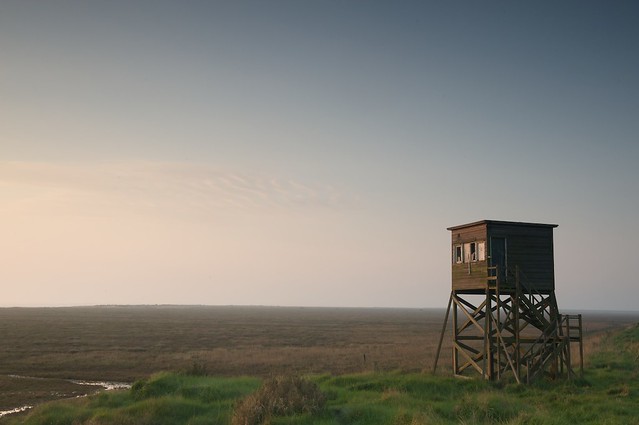
Both those examples, whilst arguably fanciful and exaggerated to make the point, are typical of how we collectively describe features of landscape images. Sometimes it’s subtle and non-specific: ‘moody‘ is rather imprecise, for example. Sometimes it’s very pointed: the image below, by Duncan George, is of an abandoned hide on the Blackwater estuary. Duncan says that it “looks out over lonely salt marsh.” Whether or not I’d have seen this image that way without the caption, I don’t know, though I suspect I would, but, having read the caption, I’m unavoidably thrown into imagining myself standing there, not beside the hide but as the hide, surveying the bleakness of the scene – and yes, feeling lonely! On one level, and ignoring the technical aspects of colour, texture and detail, this is just an old wooden shed on stilts on a rather banal, flat landscape; adding the emotional overlay and identification with the hide’s situation (or predicament!) gives the image a great deal more impact, engendering a sense of isolation and abandonment. To my eyes, that emotional and situational identification with the hut helps the image a great deal.
Time passes slowly

Another example is the following image, which Bruce Percy has kindly allowed me to use, of Olstind, a mountain on the Lofoten Islands of northern Norway. Bruce describes this mountain, in his ebook on Lofoten, as looking like an old man with a beard, perhaps wrapped in a nice, warm cloak, and talks about how he began to see the mountain as a presence whilst there, one to be engaged with. This anthropomorphic interpretation of the scene illustrates Bruce’s emotional engagement with the composition and with the surrounding landscape, and also conveys more interest in the image to me, as the viewer. It makes my whole experience of studying the photograph more involved and empathetic, both to its creation and to the end result.

Olstind, by kind permission of Bruce Percy

Back to naming and labelling then?

In each of the above two examples I drew their anthropomorphic quality from their names or captions initially, though of course I don’t know whether I’d have felt similar emotions had I seen just the images and no accompanying text. It’s obvious that words are not essential, that we as viewers can project human thoughts and emotions onto landscape elements without either being told to do so or told what those projections should be; but perhaps the use of words links the creating artist to the viewer and assists the process of appreciating their art?

Compose with anthropomorphism in mind?

I think visualising and creating compositions with anthropomorphism in mind may be a useful technique in creating the ’emotional engagement’ so often cited with reference to images of all sorts. And whilst engendering anthropomorphic feelings for the subject in the mind of the viewer is clearly easier with some subjects, and landscape photographs are certainly not amongst that group, it’s undoubtedly possible and potentially a very powerful tool in helping the viewer to engage with the finished image.

Perhaps, however, rather than seeking to deliberately construct an image with the intention of inducing the viewer to attribute emotion to weather, rocks, trees, bodies of water or mountains, it’s most effective to simply allow oneself to see things that way during composition and hope that the resulting image will produce a similar response in people looking at the finished item, as I know Bruce did with his Olstind photograph? Whichever of those two approaches you take, I have written before about the potential benefits of naming and captioning images and I still think it’s useful. If anything, this idea of using a caption or name is reinforced by the idea that we can pass on the anthropomorphic view we had when capturing the image.

At this point in my development as a photographer, all of this is very much just speculation. I’m not remotely suggesting that every image should, or indeed can, use anthropomorphism, either in itself or via associated titles and captions. What I am putting forward is the idea that doing so may well be, surprisingly often, a means of creating that much sought-after ’emotional engagement’ between the viewers and the resulting image, and that it can therefore be a useful tool in composing images. Anthropomorphising something can make it seem more understandable and predictable: we ascribe intent or intelligence, even purpose, to the objects in the frame and this helps us in our basic wish to make sense of, and connect emotionally with, an uncertain environment. People’s need to use anthropomorphism to interpret and accept their surroundings is a long-established one, and using that seemingly inherent trait must surely be a useful tool to landscape photographers.

My notes for this piece included whether or not actively treating subjects anthropomorphically is a good or a bad thing, and I’ve failed to think of any way in which it’s bad. So, I’d welcome comments on any of the above, including whether you think this is generally either positive or negative, both from the perspective of the photographer and from that of the viewer.

Oh, and I just remembered that I called by most recent image ‘Talon’, as described in my previous article on being aware of the ‘right kit’ – and at the time I wasn’t even thinking consciously about this subject!
'Talon' by Mike Green

 
Addendum
Following a comment over on Great British Landscapes, I’d like to clarify a couple of points.

Firstly, I don’t see using this technique – if such it is – as a way of invariably ‘telling a story’. Yes, it can, and if that’s what you as the photographer are trying to achieve then this may well help with directing the viewer, as may the use of captions and titles. That’s not to say that we should do that for every image though. That leads on to the second point, which is that many images probably don’t lend themselves to any anthropomorphic interpretation, and that’s perfectly reasonable. I’d estimate that fewer than 10% of my images were seen, by me as the photographer, in this way, and I’m happy with that. That’s not to say that people looking at them haven’t interpreted them anthropomorphically of course.

Essentially, what I’m suggesting in this article is that we should recognise the potential for this way of reading an image, and consider both whether we want to compose to emphasise this, and whether it’s important that the viewer understand that intent. It may well be the case that, having recognised the anthropomorphic content in a composition, we might seek to eliminate it in order to avoid distraction from our non-anthropomorphic intent when the image is viewed. That last observation, incidentally, falls into the category of ‘why this might be a bad thing’; it may well be that I don’t want viewers to see a human form in a rock!

I’m convinced that people in general have a strong, subconscious tendency to seek to see images in human terms; being aware of this proclivity on the part of both ourselves, as the photographer, and of our viewers, should be something which can help us in producing work which avoids or includes anthropomorphic interpretations, depending on the result we are seeking.

Musings on: ‘photographic tools’

Every tool, and all the time?

I’ve written a number of articles in the last few months discussing various tools we can use when making photographs. More precisely, I’ve written about the various tools I think I can make use of, in the hope that other people will find these thoughts useful and so that I can refer back to them at some unspecified point in the future (and perhaps laugh, though I hope and expect not to….!). This item is by way of clarification, since I’ve had a few emails asking questions in the general realm of ‘is it possible / desirable / necessary to use all of these things for every image?‘. In short: no, definitely not! Whichever of possible, desirable and necessary the particular instance of that question contains, the answer is an emphatic and unequivocal no!

And tools are?

I’ll firstly recap on some of the ideas I’ve covered in previous musings which are relevant here as ‘tools’, a term which I’ll define below.

In no particular order at all:

  • planning particular shots;
  • researching an area;
  • tilt-shift lenses;
  • the Photographer’s Ephemeris software;
  • naming, captioning and categorising images;
  • putting ‘meaning’ into images;
  • choosing your companions for shoots;
  • choosing the ‘right’ weather;
  • how much to post-process;
  • Google Earth ground level view for visualisation;
  • and seeing subjects as having human characteristics – anthropomorphism – my next article

To reiterate the implicit point: all of the above are tools. For some items, such as tilt-shift lenses, that’s perhaps obvious. In the future, I may write articles discussing other pieces of equipment, such as filters and post-processing software, and those are unambiguously tools, in the sense of ‘photographic equipment’ – but, in this discussion, I’m including the more ephemeral ‘approach-based‘ items as tools too. For example:

researching an area thoroughly, getting to know possible compositions, and planning when to go there, in terms of time of day, season and weather.

I find it convenient to categorise all those possible activities as tools, in the widest sense. Whether they’re physical items, aspects of technique, software, or simply ways of approaching the creation of a new photograph, thinking of them all as tools is, to me, a useful way of seeing things; it enables me to consider which subset of these items from my metaphorical ‘bag of tools’ is appropriate for a given day and a given photographic intent.

Mix and match!

Viewed in that way, the question of whether to use all these things for every shot becomes clearer. In the same way that a tilt-shift lens is neither essential nor useful for every image, the more abstract tools don’t need to be used every time either. Conversely, I don’t see anything wrong with combining any or all of these tools in the creation of a single image; it all depends entirely on what you’re trying to achieve and what you find to be both effective and enjoyable. I’m sure that, were I to try to make use of all of the above list on every image, I would begin to find this whole ‘making images’ thing more than a little laborious. Quite apart from that, it’s obvious that it’s not even possible to use every piece of photographic hardware I have available in the creation of every image – I choose what I believe to be the most appropriate selection for the job; the same principle should apply to the more liberally defined tools, such as planning and seeking to make an image ‘mean something’.

Sometimes though, when I’ve pre-visualised an image, whether of a real place or of a type of location which I’d like to find and use in a photograph, the pure logistics of getting myself there with even a chance of creating the image I’ve imagined mean that anything I can do to maximise the likelihood of success is a good thing. I have limited time for photography and I’d rather throw a few more ‘tools’ into the mix and produce an image I’m happy with than simply amble out to some location and hope. Not all the time though – wandering hopefully is intrinsically enjoyable; not every outing has to have a goal beyond ‘look at things and hope to see compositions‘. As with most activities, it’s a question of establishing some kind of balance between excessive planning and analysis, and aimless meandering in random places and conditions.

Sometimes, using no tools at all can produce tolerable results

And finally, here’s a gratuitous inclusion of an image which involved no planning, no mechanical or metaphysical tools of any kind, other than the camera and the lens mounted on it at the time, and which was shot in an impromptu break of less than a minute at a border crossing between Chile and Bolivia. I confess, however, that when I go back there next year, I do already have a plan for an image from the same place, for which I shall employ two or three extra bits of camera kit and for which I’ve done a degree of software-based pre-visualisation….. In my defence, I find playing with the whole gamut of ‘tools’ to be good fun, and for me that’s currently what photography is entirely about!

'Twin volcanoes'