Locations for photography: the Salar de Uyuni, Bolivia
Writing about the Salar de Uyuni as a photographic destination and avoiding producing a simple eulogy for this astounding location is going to be difficult and, to be honest, I’m not going to try overly hard to achieve that. I do intend, however, in amongst the superlatives which will doubtless follow, to describe the area in terms of how it can be used for photography, what I think works and how to approach it logistically.
I should also point out that I’m deliberately separating the salar from the Andes of southern Bolivia, which are immediately south of it. It would be natural – at least for anyone who’s travelling a long way to visit the salar – to combine the two areas, and I’ve done so twice now, but since they’re radically different in character I’ve decided to write another article in a week or so describing the lagoons of Bolivia and the Atacama desert, in Chile.
I am not attempting to describe every facet of the logistics or photographic options here. Details such as climate, available accommodation and transport, etc. are all available on numerous sites. This article covers primarily those items most closely related to making a successful photographic trip.

Firstly, a little of the eulogy thing and a few large numbers…
I’m a fan of barren, deserted places and wide expanses. I’m also rather enthusiastic about mountains. The Salar de Uyuni is 10,582 square kilometres (4,086 square miles) of salt, surrounded by Andean peaks and varying in thickness from ‘very little’, at the edges, to several metres over most of its area. Very approximately, it’s circular and about 100km across, slightly more in many places since it’s more of a blob than a circle. There are a few islands in this ancient, salt sea and they demonstrate the origins of the place by being composed of rock and coral, still remarkably sharp after something like 30-40,000 years since the water disappeared; one of my boots, whose toe I carelessly dragged across a piece, attests to that.
That’s enough of impressive numbers: the Wikipedia item, unsurprisingly, has a wealth of statistics and details on the geomorphology, with lots of ‘…x times larger than salt flat y…’ and similar comparisons with smaller, lower, thinner, less white salt flats! Ah yes, one last number: it’s 3,656m. above sea level, give or take less than half a metre at any point. That’s a pertinent figure to which I’ll return below under ‘altitude logistics’.
In summary: it’s a huge, startlingly flat area of very old salt dotted with cactus-covered, coral islands and with a backdrop of volcanoes. What’s not to like, at least in terms of spectacle and photographic opportunity? Admittedly, I wouldn’t want to attempt to live on it: doing so would surely be a brief and uncomfortable experience! Living temporarily on the edge of it, on the other hand, and taking daily excursions out to the islands, or to areas of nothing but salt, is fantastic! It’s about as close to other-worldly as I’ve ever come in a fair bit of travel. Forgetting about photography, just being on the salar is a brilliant experience and I’d recommend it very highly indeed.
OK, that’s most of the obvious superlatives used up so I’ll talk about photographic opportunities and logistics a little before returning to the extreme words a little later in this article.
So what is there to photograph?
At the risk of being trite: salt. Salt in lots of different patterns though, and in quantities which are pretty close to indescribable in their sheer enormity. As a foil to the salt, there are the islands. These are mostly covered with very large numbers of cacti – large cacti of the ‘several metres high’ variety – which grow in amongst the coral and rock and can be used to make excellent images as the low sunlight catches them (though not by me it seems – I was obsessing over the salt flat itself and failed to notice the photographic potential of backlit cacti).
Returning to salt… The annual cycle of water on the salar – sometimes it floods briefly and very shallowly to produce a giant mirror which can be used for stunning ‘reflected sky’ images – means that the surface forms several different types of patterns. They’re all stages on the way to becoming the classic ‘hexagonal ridges on a fine, flat surface’, which means that different areas will have, variously, lots of tiny cones, zig-zag lines, a mixture of these with visible hexagons, and the full hexagons themselves, not to mention a broad gamut of in-between stages. This variety of surface – whose changes in nature can be felt as you drive across it in the dark – is fascinating. At least, it’s fascinating to me as I like the wide range of potential foreground patterns.
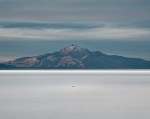
The sky-line will mostly be ‘distant mountains’, but they’re very fine mountains with some good lines of colour and folded shapes, so they do make a good back-drop to the salt. Alternatively, the few islands offer the potential for images with both salt and relatively close-by land. Of course, with a long lens, those distant volcanoes can form the major part of a composition.

And then there’s the sky
The sky is the tricky aspect of the salar, photographically. As you’d imagine, this is a dry area, meaning that the weather is consistently ‘good’, in the sense of clear and sunny. It also means that there often isn’t much in the way of cloud. There is generally enough to add some interest above the horizon at dawn and dusk though, particularly at dawn. Whilst the Sun is more than slightly above the horizon everything is bathed in very strong light, so during daytime the clouds don’t tend to be quite as relevant anyway since it’s tricky to make a worthwhile shot in those conditions. It’s still utterly spectacular of course ;-) Plus, heat hazes on the salt can give distant islands the appearance of hovering above the surface, floating in the air like the cover of a ‘Yes’ album or the floating forests from ‘Avatar’.
Colours
The colour palette is remarkable. It’s quite restricted, consisting of rather a lot of white, shades of brown and ochre in the mountains, and ‘normal’ sky colours, depending on the weather. What it doesn’t have is green, or very little of it anyway; don’t go there to photograph trees! What vegetation there is around the periphery (shore?) tends to be bleached to yellow and orange, and even the cacti are predominantly brown and red rather than green. This is perhaps partly what gives the place it’s slightly surreal appearance. Naturally, nothing but salt crystals grows on the salt itself.
Time of day
Yes, dramatic shots can be made during the hours when the Sun is above the horizon, but the salt really is very white indeed and the reflected light is extremely bright. The patterns more or less disappear under direct sunlight, at least for photographic purposes, and the coral islands suffer from harsh shadows reaching out from themselves onto the salar. If you’re taking more detailed shots then the shadow complexity of the boulders and coral, with their burden of dense cacti, is ‘unhelpful’, at best. In short, you’ll really want to be out shooting around sunset and sunrise and I liked the light best when the Sun was actually below the horizon, often by as much as half an hour (which is reasonably dark this close to the equator).
Having said that, when the Sun is very low, but visible, some of the islands can form dramatic shadows, the cacti become beautifully backlit, and if you’re spot on with timing it is just about possible to catch the light as it hits the salt surface. This next image is the second of three captures: two seconds earlier there was no direct sunshine; two seconds later there is next to no definition left in the salt. Timing is everything if you want to do this sort of thing!

Time of year
I went in winter the second time, summer the first. I preferred winter since it’s quieter and it’s well away from the wet season. I’m not that keen on the mirror effect of the flooded salar really, at least in part since if the whole salar is wet, as it can be on occasion, then that’s pretty much ‘it’: you can photograph mirrored sky and hills, but not the salt patterns, what with them being inconveniently underwater. It’s either rare or unheard of to have a flooded salar in winter; hence my preference.
The important point to note is that it really isn’t very warm first thing in the morning in winter. Specifically, it often drops to approaching minus 20 Celsius, which categorically counts as ‘really quite chilly’ to me. Dressing appropriately is critical from a health point of view, as well as in order to retain the ability to capture photographs. That said, if you do dress properly, it’s entirely fine :-)
Later in the day, however, it becomes hot. The widest range we experienced was something like minus 20 Celsius before dawn to plus 25 in the mid-afternoon. Not only do you need to dress appropriately, you need to change a lot too, unfortunately. All these minor considerations are just that though: minor. If you’re properly prepared then it’s a very fine place to be indeed, as I may have mentioned already.
Altitude logistics
That last of my numerical points above is significant, at least in terms of anyone planning a trip to photograph the salt flat. If you’ve not been to altitude before – let’s say anything over 2,500m. – then it’s important to know that Uyuni is high enough to feel the effects, but generally not severely. Two miles up, as it is, is probably going to cause minor headaches for a day or so in most people, but nothing more serious in general, though you’d certainly not want to be running around much, at least not for a few days after arrival. Of course, if you’ve been travelling around South America and have been above 3,000m. for a while then you’ll be acclimatised and won’t have any problems.
The altitude is part of why I’m discussing the salar separately from the nearby, Andean lagoons: the latter are much higher, approaching 5,000m; an altitude at which acclimatisation is not a ‘nice-to-have’ but pretty much a requirement, and one which it’s also difficult to fulfil. I’ll talk about that in the next article. For the Salar de Uyuni, however, the issue is minor and there are effectively two approaches to getting there:
– overland from La Paz and then driving south for ten hours , which for most people will involve landing in La Paz at 3,600m. (the airport’s over 4,000m. but the city is in a huge cleft beneath it which appears as if it could have been produced by a giant with a very large axe);
– overland from San Pedro de Atacama in Chile.
The advantage of the second route, quite apart from the Atacama being rather excellent, is that it’s possible to spend a little time slightly lower: San Pedro is not much over 2,000m. Unfortunately, in my experience at least, that’s not actually high enough to acclimatise much, not to mention that it’s even further overland to Uyuni from San Pedro than it is from La Paz…
I’ve twice approached from Chile and I’d do it again if necessary; however, given completely free choice I’d go via La Paz in future. As I said, altitude effects are, for most people, not too severe when well below 4,000m. and it’s logistically somewhat easier to reach Uyuni from the north. Even if you’re planning on visiting the altiplanic lagoons as well as the salar, I’d do the latter first if possible, purely since a few days at 3,656m. is excellent acclimatisation before moving to the lagoons further south.
Personally, I have a great deal of experience of being at altitude in mountains and have rarely (only once) had a problem, other than in southern Bolivia, having approached from Chile, where it’s near-unavoidable to climb from just over 2,000m. to over 4,000m. in one day and stay there. The staying there aspect is the issue: acclimatisation is broadly achieved by ‘go high, sleep low’, meaning that you ascend a nice long way then drop back down to sleep about 300m. higher than you started from in the morning, ideally. From Chile, both times I approached that way, I noticed the 2,000m. change in altitude in the form of headaches. On the other hand, Uyuni’s low enough to be just mildly discomforting for a day or two and it can be reached from either San Pedro or La Paz in one long day. Much better!

Circumstance logistics
By that I mean the question of whether you visit the salar on a normal tourist trip, on a photographic trip, or independently. If you’re primarily travelling for photography, I’d strongly advise ruling out the first, ‘normal tourist’ option. These trips are excellent, but not remotely optimised for photography since they provide insufficient time and at the ‘wrong’ times of day. If you like huge expanses of über-bright whiteness, the middle of the day is perfect, but it’s a bit limiting, to say the least. Most trips will have sunrise on one of the rock/coral islands, but the time is severely limited, not to mention that everyone else is there too, dotting the pristine expanse of the salt with vehicles and people.
The other two options are photographically very similar. Essentially, travel around the salar is by Toyota Land Cruisers; some drivers are radical enough to use other 4x4s, but they’re in a tiny minority. That means you need a driver, and most companies will insist on a guide too. So, you either need to be on a photography workshop or you need to act all patrician and hire a vehicle, driver and guide yourself. The costs are actually not vastly different since Bolivia’s a very poor country and rates are relatively low, but planning is greatly simplified by going on an organised workshop. Also, rates are relatively low, not absolutely low: hiring a vehicle, two people and their accommodation is not cheap as such! This is a pretty good option if you have two or three people and there are no workshops available; very reasonable, cost-wise, and with complete flexibility.
I imagine it’s possible to hire a vehicle and drive onto the salar yourself but this would be, at best, unwise. I’ve not asked whether it’s actually allowed and it’s not something I’d seriously consider myself: the inconvenience of getting stuck might transform itself into actual danger!
It’s probably worth pointing out that a vehicle is essential. To ‘do’ the salar you need to get out onto it. Whilst people do cycle across it, that’s more of a ‘thing to do’ than a sensible means of transporting yourself around for photography. Lots of things are possible of course – I doubt that anyone has yet crossed the salar by pogo-stick, for example – it’s just that some options will have a higher comfort factor and a greatly increased likelihood of being able to capture some worthwhile images.
Personally, for photography, I’d not consider being there with less than a vehicle and a driver. Ideally there should be two vehicles. I’m not sure whether drivers are willing to drive out onto the salar at night with one vehicle: even in the dry season (most of the year) there are soft areas at the edges and some Land Cruisers do become bogged down and require rescue. In the wet season the whole salar can be covered with water and the 40-60kph driving speed enjoyed most of the year reduces to 5kph. So, if you want that astonishing reflection from somewhere in the middle, be prepared for a long, long drive out!

Location logistics
The primary access point to the salt from the Uyuni side is via Colchani, where the salt is mined, essentially by hand at present. This is around half an hour’s drive from Uyuni itself and then you head out onto the salar through the mining area. That’s something of a grandiose term, incidentally. Essentially what it consists of is cutting troughs in the surface to form cones of salt about one metre high, using manual tools. These are then left to dry before being loaded onto the back of open trucks and stored in large piles in Colchani itself.
As an alternative to staying in Uyuni, or perhaps Colchani, there are a few salt hotels around the edges of the salar. I’ve stayed in the Tayka de Sal on the northern edge of the flats, just about in the centre of the second image in this article and a couple of hundred metres back from the edge of the salt (it’s 50km. away – definitely not visible!). As the name suggests, the hotel is constructed of blocks of salt and is of a remarkably high standard compared to most hotels in the area. I’d recommend this location above one of the many Uyuni hotels, due both to proximity to the main objective and to the views, though if you’re desperate to communicate outside Bolivia then, in common with most, if not all, locations around the area, there is no ‘net access.
I’d in fact recommend all the Tayka chain of hotels. They’re dotted across the southern Bolivian Andes and seem to offer the nicest, if not the cheapest, accommodation in the area. I stayed in the cheapest places on offer on my first trip. They’re functional, but if you’re not on a tight budget then the Tayka chain is well worth the extra expenditure.
The bottom line
As I suggested above, the Salar de Uyuni is comfortably the most bizarre and surreal place I’ve ever been and I’d recommend it very highly indeed to anyone who enjoys something a bit different.
– The sheer size and nature of the place is astounding.
– The colour palette is remarkable.
– The weather is predictable and well-suited to photography.
– The physical logistics, whilst they can take a bit of arranging, and whilst for most people they will involve a long journey, are actually not a significant problem once they’re in place.
All-in-all, it’s a fabulous photographic destination and I genuinely can’t recommend it highly enough.
As I think I said in reference to Lofoten earlier this year, if you can, go there!
Finally, if there’s something about the Salar de Uyuni that you’d like to know, or if you’d just like to comment on the place or this article, please do use the comment box below.





 mikegreenimages